Rule 9(b) revisited

FRCP 1939
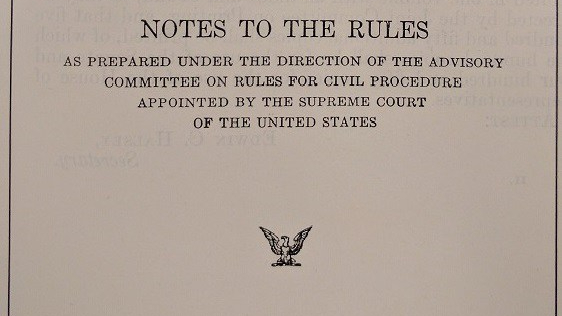
The 1939 Edition of the FRCP

A few weeks back, I wrote about Rule 9(b)’s heightened pleading standard. Rule 9(b) requires that “[i]n alleging fraud or mistake, a party must state with particularity the circumstances constituting fraud or mistake.” The Sixth Circuit recently issued a decision showing the limits of that requirement: If a claim just alleges illegal retaliation against a plaintiff who refused to go along with fraud, Rule 9(b) doesn’t apply.

Carla Crockett, an occupational therapist, sued her former employer, Complete Fitness Rehabilitation, claiming Complete Fitness broke the law when it told her to give her patients more extensive—and more expensive—therapy. Crockett also alleged that Complete Fitness illegally retaliated when Crockett balked at submitting bills she thought were fraudulent. The Eastern District of Michigan dismissed those claims, holding that both of those claims them failed to meet Rule 9(b)’s heightened pleading standard. The Sixth Circuit reversed-in-part, holding Rule 9(b) blocked the fraud claim but didn’t apply to the retaliation claim.

Although Rule 9(b) required that Crockett’s fraud claim identify particular instances of fraud her retaliation claim only had to show that Crockett had “a reasonable belief [there was] fraud.” Since the retaliation claim didn’t need to show fraud had actually been committed it only needed Rule 8’s “short and plain statement . . . .” However high the requirement, pleading is still all about notice—how much information does the defendant need to figure out what the plaintiff says they did wrong? Complete Fitness had a right to know what exactly Crockett alleged it lied about. But the rest of the complaint told Complete Fitness everything it needed to know about what else Crockett alleged was illegal.

The Sixth Circuit’s decision is here.

Where does the exhaustion defense go?

Thurgood_Marshall_United_States_Court_House
The Thurgood Marshall U.S. Courthouse, home to the Second Circuit

First, there is the complaint. And in the complaint is a short, plain, statement of the claim. But you have a defense—the plaintiff didn’t complain to the government agency first, and the plaintiff has to exhaust their administrative remedies. If the other side didn’t address this in the complaint can you get the complaint tossed? Well, unless the statute makes exhaustion jurisdictional, then exhaustion is an affirmative defense, not a prerequisite to filing suit. Federal Rule of Civil Procedure 8(c) states that “[i]n responding to a pleading, a party must affirmatively state any . . . affirmative defense . . . .” So you don’t get to write that motion to dismiss just yet—but you better read over that draft answer and make sure you’ve included your exhaustion defense.

As one example, the Second Circuit recently decided whether failure to exhaust administrative remedies must be pleaded in a Title VII suit. Curtis Hardaway sued the Hartford Public Works Department alleging retaliation and discrimination after he filed several OSHA complaints then was fired. The District of Connecticut held that, because Hardaway had failed to plead administrative exhaustion, the court had to dismiss his claim. Hardaway appealed (pro se) and the Second Circuit reversed.

The Second Circuit held that Title VII’s exhaustion requirement was an affirmative defense. Both the Supreme Court and the Second Circuit had already held that Title VII’s exhaustion requirement could be waived, estopped, and tolled—a good indication that it’s not jurisdictional. (The Supreme Court did some welcome brush-clearing on what’s jurisdictional and what’s not last year—you can read about it here). And if you look at the statute as well as the cases, “[t]he statutory scheme makes no mention of pleading requirements or question of proof relating to exhaustion.” Hardaway might not have pleaded exhaustion, but because Title VII exhaustion is an affirmative defense it wasn’t Hardaway’s job to plead it—it was Hartford’s.

The Second Circuit’s opinion is here.

Sixth Circuit: You need two of a kind to intervene

Bay Mills Slot Machine
“[A]ny effect on the interpretation of [the Indian gaming act] would be a mere side effect.”
The most basic lawsuits worry just two people, the plaintiff and the defendant. But what if you’re worried that someone else’s lawsuit is going to affect your rights?

The Federal Rules of Civil Procedure allow intervention in a lawsuit in several ways. One way is through Rule 24(b), permissive intervention. Under Rule 24(b), anyone can intervene if they have “a claim or defense that shares with the main action a common question of law or fact.” The Sixth Circuit recently gave one example of what’s not “a common question of law”: when a group wants to intervene to protect the interpretation of one law, but the suit the group wants to join is about a different law.

In 2010 Bay Mills Indian Community opened a casino in Vanderbilt, Michigan, and was promptly sued by the state government. Michigan claimed that the casino violated the Indian Gaming Regulatory Act and the gaming compact between Michigan and Bay Mills. Together these restrict casinos to “Indian land.” So Bay Mills sued Michigan right back, citing the Michigan Indian Land Claims Settlement Act. Bay Mills argued the casino was legal because the settlement act describes the land where it sat as land “held as Indian lands are held.”

Seven years later, the Saginaw Chippewa Indian Tribe of Michigan moved to intervene under Rule 24(b). The Tribe argued there was a common question of law because Bay Mills’s suit could affect how courts define “Indian land” under federal law—federal law that also applied to the Tribe. The Western District of Michigan held this wasn’t enough for a common question of law, and the Sixth Circuit affirmed.

The Sixth Circuit reasoned that the case didn’t involve the Indian gaming act at all—it involved the settlement act, and its reference to lands “held as Indian lands are held.” The Tribe wasn’t a party to the settlement act so it couldn’t be affected by any interpretation of that act. “[A]ny effect on the interpretation of [the Indian gaming act] would be a mere side effect. Allowing this to fulfill the ’common question’ requirement would mean that any Indian tribe would be able to intervene whenever IGRA is implicated in any way—or, to analogize, it would allow any employer to intervene in any Title VII suit.”

The Sixth Circuit’s decision is here.

Sixth Circuit: Can you be more specific?

pexels-photo-938967.jpeg
As the Sixth Circuit glossed Rule 9’s terms, a complaint needs “the who, what, when, where, and how of the alleged fraud.” 

Sometime early in law school we probably learn that the Federal Rules only require notice pleading. All you need is a short, plain statement of the facts that entitle your client to relief. But we might also learn that Federal Rule of Civil Procedure 9 imposes a higher pleading standard for some kinds of claims, like fraud. Rule 9(b) requires that “a party must state with particularity the circumstances constituting fraud or mistake . . . .” The Sixth Circuit recently explained just how much particularity a complaint, even a rather detailed complaint, needs in order to survive a motion to dismiss.

J. Lynn Roycroft, a former supervisor at a drug and alcohol treatment center, sued the center’s operator, Geo Group, under the False Claims Act’s qui tam section. Roycroft alleged that Geo Group had sent months of fraudulent billing claims to Ohio’s Medicaid agency. The Northern District of Ohio dismissed Roycroft’s claims because they did not meet Rule 9’s heightened pleading standard for fraud allegations, and the Sixth Circuit affirmed.

Roycroft’s complaint detailed an assortment of fraudulent practices “‘at least one or more’ of which [allegedly] rendered false or fraudulent the claims involved in the scheme.” Roycroft’s complaint then listed ten representative examples, giving the claim number, the client, the date, and what the bill was for: “A claim submitted to Medicaid for counseling services provided by Rebecca A. Wagers, CDCA, to client C.R. (000001056) on September 20, 2008).” If just one example satisfied Rule 9 then the complaint would survive.

But that setup—all-embracing allegations of fraudulent conduct coupled with a list of examples—wasn’t specific enough for Rule 9(b). As the Sixth Circuit glossed Rule 9’s terms, a complaint needs “the who, what, when, where, and how of the alleged fraud.” Roycroft’s fraudulent-conduct allegations “[spoke] in generalities, not specifics.” And “Roycroft [did] not allege that each and every claim was false in the same respect . . . . In a multifaceted scheme such as this one, the failure to allege which facet of the broader scheme is implicated in a representative claim fails to give defendants fair notice of the specific conduct with which they are charged.”

The Sixth Circuit’s decision is here, and Ms. Roycroft’s operative complaint is here.