Fifth Circuit: Takings claim not barred by Williamson County rule

wisdom_courthouse_0
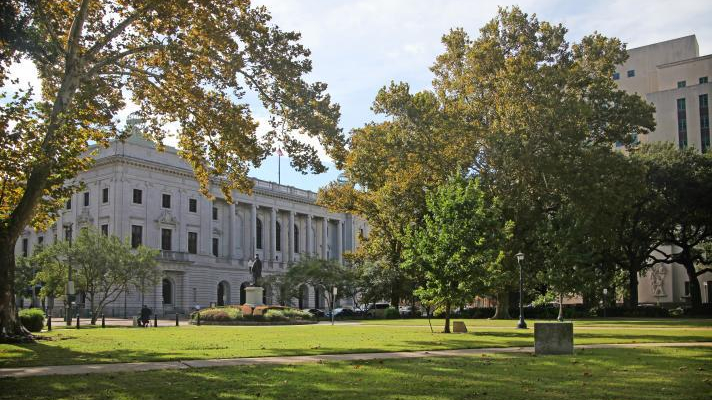
The Judge Minor Wisdom U.S. Court of Appeals Building, home of the Fifth Circuit in New Orleans

The Fifth Amendment requires that if a government takes private property, the government must pay just compensation for that property. But there are exacting rules for a well-founded takings claim. One is the Williamson County rule, named for Supreme Court ruling that a landowner suing a state for just compensation must bring their claims to state court before bringing their claims to federal court. The Supreme Court might be ready to junk this rule, but for now the Fifth Circuit just issued an opinion showing one time where the rule does not bar a takings claim.

Lourdes Archbold-Garrett and David Garrett bought a townhome from the City of New Orleans at a tax sale in 2015; four months later, New Orleans demolished the townhome without warning. Lourdes and David sued New Orleans, alleging violations of their due process rights and of the takings clause of the Fifth Amendment. New Orleans moved to dismiss, arguing the due process claims were not ripe and that Williamson County barred the takings claim. The district court agreed.

The Fifth Circuit reversed, holding that the landowners’ due process claims were ripe, and that Williamson County did not bar the takings claim. The Fifth Circuit observed that Williamson County’s state-claim rule “is a prudential doctrine, rather than a strict jurisdictional bar.” The circuit had “not previously decided a case in which prudential factors justified disregarding Williamson County’s state-litigation requirement . . . .” But, having decided that Lourdes and David’s due process claims were ripe, the Fifth Circuit held that the takings claims should go forward: “Sending [Lourdes and David’s] takings claim back to state court while their due process claim remains in federal court would needlessly generate additional legal expenses for the parties and would result in piecemeal litigation, which does not serve judicial economy.”

Read the Fifth Circuit’s opinion here.

Sixth Circuit declines to rule on EAJA attorneys’ fees

Potter Stewart Courthouse
The Potter Stewart U.S. Courthouse in Cincinnati

The general rule in federal litigation is that each party pays its own attorneys’ fees. But general rules always have exceptions. When a lawsuit is brought by or against the federal government, and the government loses, the winner can recover attorneys’ fees and costs under the Equal Access to Justice Act. The fees must be reasonable and are only available if the government’s position was not “substantially justified.” But EAJA just states that “a court shall award” those costs and fees. When a case has gone up on appeal, a winning party must choose between filing its EAJA petition in the court of appeals or in the trial court. The Sixth Circuit recently illustrated this quirk when it sent an EAJA petition back to the trial court without deciding if the Sixth Circuit had the authority to hear the petition.

The Department of Labor sued Cathedral Buffet, a church-run restaurant, under the Fair Labor Standards Act. The trial court ruled against Cathedral, but the Sixth Circuit reversed. Then Cathedral filed an EAJA petition for costs and attorneys’ fees with the Sixth Circuit.

The Sixth Circuit denied the motion and sent the case back to the trial court to rule on Cathedral’s EAJA petition. Noting that EAJA “does not specify where a petition for costs and fees may or must be filed,” the Sixth Circuit observed that “it remains an open question in this circuit” whether the Court of Appeals can decide an EAJA petition. But in Cathedral’s case, where “fees are sought for the entire litigation,” the district court was in a better position to decide if the government’s case had been substantially justified.

The Sixth Circuit rejected Cathedral’s arguments which the court “distilled to a single point: [Cathedral] does not wish to argue before the district court that the DOL’s position in this case was unreasonable, when that same district court adopted the DOL’s position . . . .” But although this was “understandable,” judicial economy favored sending the petition back to the trial court, especially since more fact-finding might be needed. The Sixth Circuit, after all, “do[es] not have a witness chair. . . .”

Read the Sixth Circuit’s opinion here.

Sixth Circuit: “Entity” is not ambiguous

photo of green field near mountains
Photo by Tim Mossholder on Pexels.com

The Administrative Procedure Act allows you to challenge a federal agency’s decision as either unsupported by the factual record or not allowed by the agency’s governing statutes. If the agency’s governing statute is ambiguous, then the court must defer to an agency’s interpretation of that statute—a rule known as Chevron deference. But if you can convince a court that the statute is not ambiguous, then the agency gets no deference. The Sixth Circuit has recently ruled on an APA case highlighting the change this can make.

Sunrise Cooperative is an agricultural cooperative with members in Ohio, Michigan, and Indiana. Sunrise also owns a crop-insurance company. When Sunrise’s members buy crop insurance from that company, Sunrise gives those members agricultural-insurance rebates.

This kind of rebate was only briefly lawful, from 2000 until 2008. But when Congress banned the system again in 2008, it added a grandfather clause allowing rebates if the “entity” giving them had been allowed to give them under the old law. After the ban was put back in place, Sunrise merged with another cooperative; the U.S. Department of Agriculture held that Sunrise could no longer pay rebates, reasoning that after the merger Sunrise was no longer the same “entity.”

Sunrise sued under the APA, arguing that the Department’s ruling was against the statutory text. The district court found the term “entity” ambiguous and deferred to the agency under Chevron. But the Sixth Circuit disagreed, holding that “entity” is an unambiguous term—and that Sunrise was indeed the same “entity” after its merger as it was before the merger.

The Sixth Circuit began with the text, noting that “[w]hile Congress did not define ‘entity,’ the term is not ambiguous. . . .  In everyday speech, an ‘entity’ is ‘an organization (such as a business or governmental unit) that has an identity separate from its members.” The agency relied on a “‘functional’ reading of ‘entity,’ [that] considers, ‘in a practical sense,’ an increase in membership ‘and the attendant increase in premium-rebating that comes with the expanded membership’ . . . .” Because the text was unambiguous, the Sixth Circuit refused to follow the agency’s reading.

The Sixth Circuit also rejected the Department’s argument that “the statute defines the term ‘legal entity,’ but it does not define ‘entity’ standing alone.” The agency urged the court to follow the definition for “legal entity,” which would not have allowed Sunrise to provide rebates. But the Sixth Circuit noted that the same terms have the same meaning “only when the term at issue is the same. ‘Entity’ (undefined) and ‘legal entity’ (defined) are not.”

Read the Sixth Circuit’s decision here.

Consenting to jurisdiction not enough for forum non conveniens

sao-paulo-stryker.jpg
Sao Paulo, home of the Associação Brasileira de Medicina de Grupot (by Jurema Oliveira)

As a rule, a federal court must hear a case if it has jurisdiction. But it can dismiss a case when there are compelling reasons why the case should have been brought somewhere else. Motions to dismiss for forum non conveniens require the movant to show that there’s an adequate alternative forum. Proving that the federal court is inconvenient isn’t enough—as the Tenth Circuit has put it, “[s]ometimes an inconvenient forum is the only available forum.” The Sixth Circuit recently issued an opinion that nicely shows what a party must prove to get a case dismissed based on forum non conveniens.

Associação Brasileira de Medicina de Grupot, a Brazilian nonprofit association of private health insurance providers, sued Stryker Corporation, a Michigan company that makes medical products. The nonprofit alleged that Stryker had masterminded an illegal scheme of bribes and kickbacks to encourage Brazilian doctors to use Stryker’s products. The Western District of Michigan dismissed under the doctrine of forum non conveniens. The nonprofit appealed, and the Sixth Circuit reversed, holding that the trial court had abused its discretion.

The Sixth Circuit noted that a party can usually show that another court would have jurisdiction by using expert testimony. But Stryker didn’t even cite Brazilian law. Instead, Stryker argued that because it would consent to a Brazilian court’s jurisdiction, “Brazil is an available forum.”

The Sixth Circuit noted that the only support for this argument was a single-line statement in Stryker’s motion to dismiss. Not only is “an attorney’s statement in a brief . . . not evidence,” “Stryker has provided no evidence its consent to jurisdiction in Brazil would be legally meaningful . . . .” The Sixth Circuit analogized Stryker’s consent to jurisdiction to a “a party’s consent to a federal court’s jurisdiction over her state-law claim worth $50,000”—consent that “would not be legally meaningful; regardless of her consent, the federal court would be unable to hear the case for lack of subject-matter jurisdiction.”

Because Stryker had the burden to prove no adequate alternative forum was available, the motion should not have been granted. The Sixth Circuit reversed, with permission for Stryker to refile its motion with supporting documents on remand.

Read the Sixth Circuit’s opinion here.